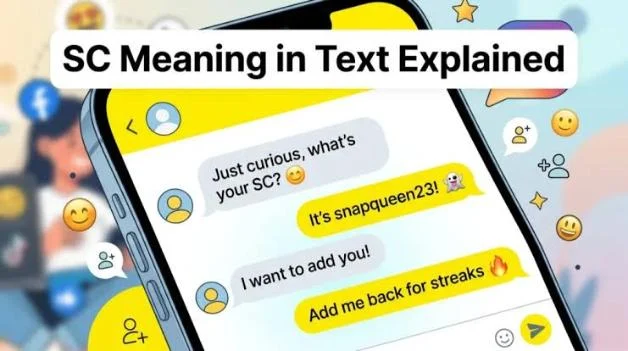
When someone sends you “SC” in a text or chat, the meaning may not always be obvious. Unlike some slang terms that have one clear definition, SC can stand for several different things depending on the conversation.
In casual texting, it may have a short meaning related to social media, school, relationships, or everyday communication.
People often search for “SC meaning in text” because they see the abbreviation in messages, comments, captions, or social media posts and want to understand what the sender means.
The good news is that figuring out SC is usually easy when you look at the words around it. This guide explains the common meanings of SC, how people use it on popular apps, and how to respond when someone sends it to you. Let’s explore it in a simple and practical way.
What Does SC Mean in Text & Chat?

In text messages and online chats, SC can have different meanings depending on the context. There is no single definition that works for every conversation. The most common interpretation is often “Snapchat”, especially when people are talking about social media or exchanging usernames.
For example, someone might say:
- “What’s your SC?”
- “Add me on SC.”
- “I saw your story on SC.”
- “Do you use SC?”
In these examples, SC means Snapchat.
However, SC can also mean other things. In some conversations, it may be used as an abbreviation for phrases such as “screenshot,” “self-care,” “Santa Claus,” “South Carolina,” or other terms.
The surrounding conversation is the best clue.
For example:
- “Send me the SC” → could mean screenshot
- “What’s your SC?” → likely Snapchat
- “I need some SC today” → could mean self-care
- “She lives in SC” → likely South Carolina
This is why searching for SC meaning in text can sometimes produce several answers. The correct meaning depends on who is talking, what they are discussing, and where the abbreviation appears.
If you are unsure, asking the person directly is perfectly normal.
Full Form, Stands For & Short Meaning of SC
The full form of SC changes according to the situation. In casual online conversations, Snapchat is one of the most common meanings, especially among social media users.
Here are several meanings you may encounter:
- SC = Snapchat — common in social media conversations.
- SC = Screenshot — sometimes used when discussing saved or captured images.
- SC = Self-Care — used in conversations about relaxation and personal well-being.
- SC = South Carolina — commonly used as the U.S. state abbreviation.
- SC = Santa Claus — sometimes used in holiday-related conversations.
- SC = School — may appear as an informal abbreviation in certain contexts.
- SC = Stay Connected — occasionally used in casual messaging.
- SC = Snapchat Score — sometimes used when discussing Snapchat activity.
The meaning is usually easy to identify once you examine the sentence.
For instance, if someone asks, “What’s your SC?”, they are probably asking for your Snapchat information.
If someone says, “Can you send the SC?”, they might mean a screenshot.
So, the short meaning of SC cannot be determined from the letters alone. You need the context.
This is especially important because abbreviations are often created simply to save time. Different groups of friends may even use SC differently.
Origin, History & First Known Use of SC
Unlike some internet slang terms, SC does not have one clear origin or one specific person who created it. It is an abbreviation made from the first letters of different words and phrases.
The use of shortened words became increasingly common with texting, instant messaging, and social media. People began using abbreviations because they could communicate faster with fewer characters.
As social platforms became popular, SC began appearing as a short way to refer to Snapchat in some online conversations. Instead of typing the full platform name, users could simply write “SC.”
For example:
- “Are you on SC?”
- “Send me your SC.”
- “I posted it on SC.”
- “My SC is in my bio.”
The abbreviation can also have much older or unrelated uses. South Carolina, for example, has long been abbreviated as SC in geographical contexts. Other meanings developed naturally in different communities.
There is therefore no single “first use” of SC as modern internet slang. Its meaning developed according to the words it represented and the communities using it.
Today, the abbreviation is especially easy to understand when it appears next to words such as add, story, streak, username, snap, or app. Those clues usually suggest Snapchat.
How People Use SC in Daily Conversations
People use SC in many different ways during casual conversations. The exact meaning depends on the topic.
When SC refers to Snapchat, it often appears when people want to connect on the platform.
Examples include:
- “What’s your SC?”
- “Drop your SC.”
- “Add me on SC.”
- “Do you have SC?”
- “I’ll send it on SC.”
SC can also refer to a screenshot in informal conversations.
For example:
- “Can you send the SC?”
- “I need an SC of the message.”
- “Take an SC and send it to me.”
In conversations about personal well-being, someone might use SC to mean self-care.
For example:
- “Today is all about SC.”
- “I need some SC after this week.”
- “Don’t forget your SC.”
You should also pay attention to capitalization. Some people write SC, while others may write sc. In casual texting, capitalization often does not change the intended meaning.
If the meaning is unclear, look at the words around it. A sentence containing “story,” “streak,” or “add” probably relates to Snapchat. A sentence mentioning “send,” “picture,” or “message” might refer to a screenshot.
SC Meaning Across WhatsApp, Instagram, TikTok & Snapchat
The meaning of SC can change slightly depending on the social platform where you see it.
On WhatsApp, SC may refer to Snapchat when someone is asking to move a conversation to another app.
Example:
- “What’s your SC? 😊”
It can also mean screenshot if someone asks you to capture a message.
On Instagram, people may use SC when talking about their Snapchat account.
Examples:
- “My SC is in my bio.”
- “Follow me on IG and add me on SC.”
It may also appear in comments or direct messages.
TikTok
TikTok users may use SC when sharing social media details or asking others to connect elsewhere.
For example:
- “Anyone want my SC?”
The exact meaning still depends on the surrounding words.
Snapchat
On Snapchat itself, SC may refer to Snapchat or sometimes Snapchat Score, depending on the discussion.
For example:
- “What’s your SC?”
- “My SC went up today.”
Because abbreviations are informal, there is no universal rule that every user follows. Always consider the context before deciding what SC means.
Different Meanings of SC in Other Fields
SC is not limited to texting or social media. The abbreviation appears in many professional, academic, geographic, and technical settings.
Some examples include:
- South Carolina — a U.S. state.
- Supreme Court — commonly shortened to SC in some contexts.
- Supply Chain — used in business and logistics.
- Student Council — used in schools and colleges.
- Source Code — common in software and programming.
- Service Center — used by businesses and organizations.
- Self-Care — common in lifestyle conversations.
- Santa Claus — used in holiday-related discussions.
- Screenshot — informal digital communication.
- Snapchat — common in social media conversations.
This wide range of meanings explains why SC meaning in text can be confusing.
For example, a programmer might use SC to mean source code, while a teenager may use it to mean Snapchat. Someone discussing American geography may mean South Carolina.
The important lesson is simple: never interpret an abbreviation without looking at its context.
If SC appears in a professional document, its meaning may be completely different from its meaning in a text message.
Common Confusions, Mistakes & Wrong Interpretations
One of the biggest mistakes people make with SC is assuming that it always means Snapchat.
While Snapchat is a common interpretation in casual social conversations, it is not the only one.
For example:
- “I need the SC from yesterday.” → Could mean screenshot
- “I live in SC.” → Probably South Carolina
- “Check the SC before submitting.” → Could mean source code
- “My SC is getting better.” → Could mean self-care, depending on context.
Another common mistake is confusing SC with similar abbreviations. Someone may use “SS” for screenshot, while another person may use “SC.” Informal texting does not always follow fixed rules.
People also sometimes assume that capitalization gives a definite answer. It usually does not. Both SC and sc can be used casually.
If you receive a message that simply says:
“What’s your SC?”
the context may suggest Snapchat, but if you are unsure, you can simply ask:
“Do you mean Snapchat?”
That small question can prevent confusion.
Similar Terms, Alternatives & Related Slang
Several abbreviations and slang terms can appear alongside SC in online conversations.
If SC means Snapchat, you may also see:
- Snap — a photo or video sent through Snapchat.
- Streak — consecutive days of exchanging snaps.
- Snap score — a number associated with Snapchat activity.
- Add me — a request to connect on a social platform.
- DM — direct message.
- PM — private message.
- IG — Instagram.
- TT — TikTok, in some casual contexts.
- SS — screenshot.
- PFP — profile picture.
If SC means screenshot, related expressions include:
- Screenshot
- Screen grab
- Capture
- Snap a pic
For your website, useful internal links could include:
- What Does DM Mean in Text?
- What Does IG Mean in Text?
- What Does SS Mean in Chat?
- What Does PFP Mean in Text?
- What Does PM Mean in Chat?
- What Does Snap Mean on Snapchat?
These related pages can help readers understand other common abbreviations they may encounter online.
Examples of SC in Real Chat Situations
Seeing SC in complete conversations makes the meaning much easier to understand.
Example 1: Snapchat
Alex: “Are you on SC?”
Sam: “Yeah, what’s your username? 😊”
Here, SC clearly means Snapchat.
Example 2: Screenshot
Alex: “Can you send me the SC?”
Sam: “Sure, one sec.”
Here, SC likely means screenshot.
Example 3: South Carolina
Alex: “Where does your cousin live?”
Sam: “She lives in SC.”
Here, SC means South Carolina.
Example 4: Self-Care
Alex: “What are you doing this weekend?”
Sam: “Nothing much. Just some SC and relaxing 😌”
Here, SC could mean self-care.
Quick clues
- “Your SC?” → likely Snapchat
- “Send the SC” → likely screenshot
- “Lives in SC” → likely South Carolina
- “Need some SC” → possibly self-care
Context is the key to understanding the abbreviation.
How to Reply When Someone Says SC
Your response should depend on what the other person means by SC.
If they are asking for your Snapchat, you can respond naturally:
- “Sure, my username is ___.”
- “Yeah, I’ll add you.”
- “I’ll send you my SC.”
If they mean a screenshot, you can say:
- “Sure, I’ll send it.”
- “Give me a second.”
- “I’ll take one now.”
If you do not understand what they mean, asking is completely fine:
- “SC as in Snapchat?”
- “Do you mean screenshot?”
- “What do you mean by SC?”
There is no need to guess when the context is unclear.
If someone says “What’s your SC?”, a simple response such as “Do you mean my Snapchat?” can quickly clear things up.
The best reply is always based on the conversation. Short abbreviations are meant to make communication faster, not more confusing.
Is SC Still Popular? Trends & Online Usage
SC is still used online, but its popularity depends heavily on the meaning and the community using it.
When people use SC as a short form for Snapchat, it may appear in casual conversations where users are sharing social mediaHuh Meaning in Text: What Does Huh Mean in Chat?
Introduction
If you have received a message that simply says “huh”, you may wonder what the person really means. The huh meaning in text can change depending on the conversation, punctuation, and tone. In most chats, “huh” is used to show confusion, surprise, disbelief, or that someone did not understand what was said. Sometimes, it can also be a casual way to ask someone to repeat themselves.
People often search for the meaning of “huh” because short text messages can be difficult to understand without hearing the speaker’s voice. A simple “huh?” may sound curious, while “huh.” can feel more serious or annoyed. This guide explains the different meanings of “huh” in texting and online conversations. You will also learn how people use it on popular social platforms, how to reply, and how to understand its meaning from context.
What Does Huh Mean in Text & Chat?
The word “huh” is a short expression commonly used in text and chat to show that someone is confused, surprised, doubtful, or did not hear or understand something. The exact meaning depends heavily on the situation.
When someone sends “huh?”, they are often asking you to explain something or repeat what you said. It can be similar to saying, “What?” or “What do you mean?”
For example:
- Person A: “I saw your brother at the mall.”
- Person B: “Huh? He’s out of town.”
Here, “huh?” shows surprise and confusion.
The word can also express disbelief:
- Friend: “I finished the entire project in one hour.”
- You: “Huh?! 😳”
In this case, the sender is surprised by the statement.
Sometimes “huh” is used when someone does not fully understand a situation:
- A: “The meeting was moved to Sunday.”
- B: “Huh? I thought it was Monday.”
In casual conversations, “huh” does not always have a strong emotional meaning. It can simply mean that the person needs more information.
Punctuation makes a big difference:
- “Huh?” = confusion or request for clarification
- “Huh?!” = strong surprise or disbelief
- “Huh.” = possible doubt, annoyance, or a dismissive reaction
- “Huh…” = thinking, uncertainty, or hesitation
Therefore, understanding the huh meaning in text requires looking at the complete message and the conversation around it.
Full Form, Stands For & Short Meaning of Huh
Unlike many texting abbreviations, “huh” does not have a standard full form. It is not normally an acronym where each letter represents another word. Instead, “huh” is an informal expression used in everyday speech and writing.
Its short meaning can vary based on context.
Common meanings include:
- What?
- I don’t understand.
- Can you repeat that?
- Really?
- What do you mean?
- I’m surprised.
- I’m confused.
- That’s strange.
For example, if someone texts “Huh?”, they may simply be asking you to repeat your message.
If someone writes “Huh, really?”, they are showing surprise or curiosity.
If someone says “Huh…”, they may be thinking about what you said or expressing uncertainty.
This makes “huh” different from abbreviations such as “LOL,” “BRB,” or “IDK.” Those terms have commonly recognized meanings or expanded forms. “Huh” is an expression rather than a shortened phrase.
Quick meaning
Huh = What? / I don’t understand / Really?
However, this is only a general guide. The meaning can change depending on the relationship between the people, the subject being discussed, and the punctuation used.
For example:
- “Huh?” → “Can you say that again?”
- “Huh?!” → “Seriously? I can’t believe that!”
- “Huh…” → “I’m not sure what to think.”
- “Huh, okay.” → “That’s interesting or unexpected.”
So, when you see “huh” in a message, do not automatically assume the sender is being rude. It may simply be a natural reaction to something they did not understand.
Origin, History & First Known Use of Huh
“Huh” is an old conversational expression rather than a modern internet abbreviation. People have used similar sounds in spoken language for a very long time to signal confusion, request repetition, or react to something unexpected.
The expression is closely connected to natural human conversation. When people do not hear something clearly, they often make a short sound such as “huh?” instead of immediately asking a longer question. Over time, this expression became common in informal writing as well.
The modern internet has made “huh” even more common because texting removes many parts of face-to-face communication. In person, a person can use facial expressions, body language, or tone of voice to show confusion. In a text message, a short expression like “huh?” can perform some of the same functions.
Today, people use “huh” across:
- Text messages
- Group chats
- Social media comments
- Online gaming
- Messaging apps
- Forums
- Casual emails
Its meaning has also become more flexible online. A person might type “huh” because they are confused, surprised, skeptical, amused, or simply reacting to an unusual statement.
Punctuation and capitalization can add extra meaning. For example, “HUH?!” can show a much stronger reaction than “huh?”
It is also important to remember that there is no single universal emotional meaning. A close friend might use “huh” playfully, while another person might use the same word because they are genuinely confused.
The safest way to understand it is to consider the surrounding conversation rather than treating “huh” as a fixed slang abbreviation.
How People Use Huh in Daily Conversations
People use “huh” in many everyday situations. Its meaning usually becomes clear from what comes before or after it.
One common use is asking someone to repeat something.
- “Huh? I didn’t hear you.”
- “Huh? What did you say?”
Another use is showing surprise.
- “Huh?! You actually met him?”
- “Huh, I didn’t know that.”
It can also show confusion about a situation.
- “Huh? Why is the store closed?”
- “Huh? I thought we were meeting at 7.”
Sometimes people use “huh” to show mild disbelief.
- “Huh… that’s interesting.”
- “Huh, I never thought about it that way.”
In casual conversations, the expression can even be playful. Friends may send “huh 😂” after hearing something unexpected or funny.
Common examples
- “Huh?” — Please repeat that.
- “Huh? Really?” — I’m surprised.
- “Huh 😂” — That’s funny or unexpected.
- “Huh…” — I’m thinking about that.
- “HUH?!” — Strong surprise or confusion.
Tone is especially important. A person who normally uses short messages may write “huh” without intending anything negative. Another person may use it to show irritation.
Therefore, it is better to look at the entire conversation before deciding what the sender means.
Huh Meaning Across WhatsApp, Instagram, TikTok & Snapchat
The huh meaning in text is generally similar across messaging and social media platforms, but the way people use it can differ slightly.
On WhatsApp, “huh?” commonly means:
- “What did you say?”
- “What do you mean?”
- “I don’t understand.”
- “Really?”
For example:
Friend: “I’m moving next week.”
You: “Huh? 😳 Where?”
On Instagram, “huh” may appear in direct messages, comments, or replies. It can be a reaction to an unexpected post or statement.
Example:
“Huh?! How did you do that?”
In comments, “huh” can also be used humorously when a video or post seems strange.
TikTok
TikTok users may use “huh” as a quick reaction to confusing, surprising, or unusual content.
Examples:
- “Huh 😭 what did I just watch?”
- “Huh?! 😂”
- “Wait… huh?”
It may be part of a humorous reaction rather than a serious question.
Snapchat
On Snapchat, conversations are often short and casual. “Huh?” may simply mean the person did not understand your message.
For example:
“Huh? I can’t see what you mean.”
The key point is that the platform usually does not change the basic meaning. Context, punctuation, and the relationship between the people are more important.
Different Meanings of Huh in Other Fields
Although “huh” is mainly used as a conversational expression, it can appear in different settings with slightly different functions.
In everyday conversation, it can be a request for clarification:
“Huh? Could you repeat that?”
In casual writing, it may show surprise:
“Huh, that’s unexpected.”
In informal storytelling, “huh” can represent a person’s spoken reaction. Writers sometimes use it to make dialogue sound natural.
In online conversations, it can also be used as a reaction rather than a literal question. For example:
“Huh 😂”
This might mean, “That was unexpected,” rather than “I did not hear you.”
There are also situations where “huh” appears in discussions about language or communication. Linguists may study words such as “huh?” because short conversational expressions can help people manage communication when something is unclear.
However, “huh” should not automatically be treated as an abbreviation or technical term. In most text messages, it is simply an informal conversational expression.
Context changes the meaning
- Conversation: “Huh?” = I didn’t understand.
- Surprise: “Huh?!” = That’s unexpected.
- Thinking: “Huh…” = Let me think.
- Reaction: “Huh 😂” = That’s strange or funny.
- Doubt: “Huh, okay.” = I’m not completely convinced.
So, if you encounter “huh” outside normal texting, check the surrounding words before assigning a specific meaning.
Common Confusions, Mistakes & Wrong Interpretations
One of the biggest mistakes people make with “huh” is assuming that it always sounds rude. In reality, the word can be completely neutral.
For example:
“Huh? Sorry, I didn’t hear you.”
This is simply a request for repetition.
However, a message like:
“Huh.”
may sound more distant or dismissive because there is no question mark and the response is very short.
Another common mistake is assuming that “huh” has a hidden full form. Unlike many popular texting abbreviations, it generally does not. It is an expression used in speech and informal writing.
People may also misunderstand the meaning because text does not include vocal tone. In spoken conversation, a person can say “huh?” with a friendly voice. In text, the same word may appear blunt.
Avoid these assumptions
- Do not automatically assume “huh” means anger.
- Do not assume it always means “I don’t understand.”
- Do not treat it as an acronym.
- Do not ignore punctuation.
- Do not interpret one word without considering the conversation.
If you are unsure, the easiest solution is to ask:
“What do you mean?”
or
“Did you mean you were confused?”
A short clarification can prevent unnecessary misunderstandings.
Similar Terms, Alternatives & Related Slang
Several words and texting expressions can have meanings similar to “huh.” However, they are not always interchangeable.
What?
“What?” is one of the closest alternatives. It can ask someone to repeat information or explain something.
Hmm
“Hmm” usually shows thinking, uncertainty, or consideration. It is often less directly confused than “huh.”
Eh?
“Eh?” can be used to ask for repetition or show uncertainty. Its use can vary by region and speaking style.
Wait
“Wait” often signals surprise or confusion.
“Wait, what? 😳”
IDK
“IDK” means “I don’t know.” It is different from “huh” because it directly communicates uncertainty about an answer.
WTF
“WTF” is a much stronger and more informal reaction. It can express shock, confusion, or disbelief and may be inappropriate in some conversations.
Really?
“Really?” usually shows surprise, doubt, or a request for confirmation.
Related slang pages
For internal SEO linking, you could link this article to related pages such as:
- [What Does IDK Mean in Text?]
- [What Does LOL Mean in Chat?]
- [What Does WTF Mean in Text?]
- [What Does BTW Mean in Texting?]
- [What Does WYM Mean in Chat?]
- [What Does Hmm Mean in Text?]
These related pages can help readers understand other short expressions they may encounter online.
Examples of Huh in Real Chat Situations
Seeing “huh” in a real conversation makes its meaning much easier to understand. Here are several common situations.
Example 1: Asking for repetition
Alex: “The class starts at 6.”
Sam: “Huh? I thought it started at 7.”
Here, “huh?” shows confusion.
Example 2: Showing surprise
Alex: “I met your favorite actor yesterday.”
Sam: “Huh?! 😳”
The response shows surprise.
Example 3: Showing uncertainty
Alex: “Maybe we should leave earlier.”
Sam: “Huh… maybe.”
Here, “huh…” suggests the person is thinking about the suggestion.
Example 4: Reacting to something funny
Alex: “He tried to cook and burned the toast.”
Sam: “Huh 😂”
The expression is a casual reaction to something unexpected or amusing.
Example 5: Asking for clarification
Alex: “We’re changing the plan.”
Sam: “Huh? What changed?”
The sender wants more information.
Quick examples
- “Huh? What happened?”
- “Huh?! You won?”
- “Huh, that’s weird.”
- “Huh… let me think.”
- “Wait, huh? 😂”
The same word can communicate different feelings, so the surrounding messages are important.
How to Reply When Someone Says Huh
The best response depends on why the person said “huh.” If they seem confused, explain your message clearly.
For example:
Them: “Huh?”
You: “Sorry! I meant that the meeting starts at 5.”
If they are surprised, you can provide more information:
Them: “Huh?! You bought a new car?”
You: “Yeah! I picked it up yesterday 😄”
If you are not sure what they mean, ask them directly:
- “What part was confusing?”
- “Did you want me to explain?”
- “What do you mean?”
- “Did you not hear me?”
- “Want me to say that another way?”
For a playful conversation, you can respond casually:
- “Haha, I know 😂”
- “I know, right?”
- “Surprise! 😄”
- “Yep, you heard me!”
If their “huh” seems annoyed, avoid immediately becoming defensive. A calm explanation usually works better.
Simple replies
- Confused: “Sorry, let me explain.”
- Surprised: “Yep, seriously!”
- Didn’t hear: “I said the meeting is tomorrow.”
- Joking: “Haha, exactly 😂”
- Unsure: “Which part are you asking about?”
Your response should match the tone of the conversation.
Is Huh Still Popular? Trends & Online Usage

Yes, “huh” remains a common expression in casual communication because it is a natural part of everyday language. Unlike some internet abbreviations that become popular for a short period and then disappear, “huh” has existed in spoken communication for a long time.
Its continued use in texting is partly due to its simplicity. A person can type “huh?” instead of writing a longer sentence such as “What did you mean?” This makes it useful in fast conversations.
Social media has also created new ways to use the expression. People may write:
- “Huh 😭”
- “Wait, huh?”
- “Huh?! 😂”
- “Umm… huh?”
- “Huh 💀”
These combinations often add humor or exaggerate a reaction.
The emoji or extra punctuation can change the emotional tone. For example, “huh?” is usually straightforward, while “HUH?! 😭” may communicate dramatic surprise.
Because “huh” is so short and flexible, it continues to appear in private messages, comments, group chats, gaming conversations, and social media posts.
Its meaning has not become fixed to one internet definition. Instead, users continue to adapt it according to context, tone, and platform.
Frequently Asked Questions
What does huh mean in texting?
In texting, “huh” usually means “what?”, “I don’t understand,” or “can you repeat that?” It can also express surprise or disbelief.
Is huh an abbreviation?
No. “Huh” is generally not an abbreviation or acronym. It is an informal conversational expression.
What does “huh?” mean from a girl?
“Huh?” does not have a special meaning based on gender. It usually means the person is confused, surprised, or asking you to repeat something.
What does “huh?!” mean in text?
“Huh?!” usually expresses stronger surprise, confusion, disbelief, or shock. The combination of the question mark and exclamation mark makes the reaction stronger.
Is saying huh rude?
Not necessarily. “Huh?” can be completely normal and polite in casual conversation. However, “huh.” or a very short response can sometimes sound dismissive depending on the context.
What does “huh…” mean?
“Huh…” can show that someone is thinking, uncertain, surprised, or unsure how to respond.
What should I reply to “huh?”
If the person seems confused, explain your previous message. You can say, “Sorry, I meant…” or “Let me explain.”
Does huh mean I don’t know?
Not usually. “Huh” generally expresses confusion, a request for clarification, or surprise. “IDK” is the more direct abbreviation for “I don’t know.”
Conclusion:
The huh meaning in text is usually connected to confusion, surprise, disbelief, or a request for clarification. It is a simple conversational expression rather than a standard abbreviation with a fixed full form.
A message such as “Huh?” often means “What?” or “Can you repeat that?” while “Huh?!” can show stronger surprise. On platforms such as WhatsApp, Instagram, TikTok, and Snapchat, the basic meaning stays similar, but emojis, punctuation, and context can change the tone.
When someone sends “huh,” avoid assuming they are being rude. Look at the conversation first. If their meaning is unclear, simply ask for clarification.
Understanding these small details can make online conversations easier and help prevent unnecessary misunderstandings. In short, “huh” is a flexible and still-common expression that gets its meaning from context.

Oyner is the creator of DailyWishz, passionate about sharing thoughtful wishes, positive messages, and little moments of joy. He believes the right words can brighten anyone’s day.