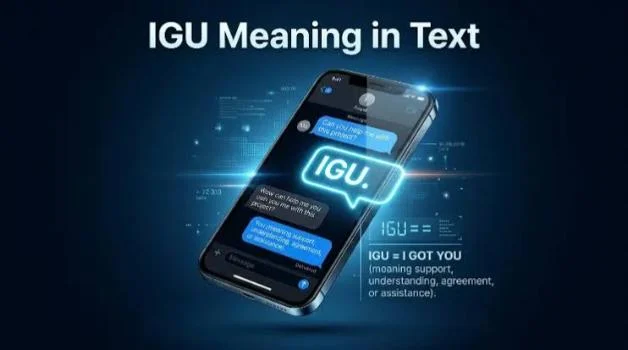
If you have received a message containing “IGU”, you may have wondered what those three letters mean. In texting and online chats, IGU can have more than one meaning, and the conversation around it usually provides the best clue. One common interpretation is “I Got You,” which can mean “I understand,” “I’ll help you,” or “I’ll take care of it.”
Another common interpretation is “I Give Up,” which expresses frustration, surrender, or playful defeat.
People search for the IGU meaning in text because abbreviations can be confusing when they appear without context.
You might see IGU in a WhatsApp message, Instagram DM, Snapchat chat, TikTok comment, or group conversation. This guide explains the different meanings of IGU, how people use it, and how to reply naturally.
What Does IGU Mean in Text & Chat?
In casual texting, IGU can mean “I Got You” or “I Give Up.” The intended meaning depends on the situation, the message before it, and sometimes the emoji used with it.
When IGU means “I Got You,” it usually expresses support, understanding, agreement, or a willingness to help. For example, if someone asks, “Can you bring my book tomorrow?” a reply of “IGU” can mean “I got you” or “I’ll take care of it.”
When IGU means “I Give Up,” it communicates frustration, defeat, or surrender. Someone might use it after trying to solve a difficult problem or during a playful argument.
Quick meanings of IGU
- I Got You — I understand or I will help.
- I Give Up — I am done trying or I surrender.
- I Get You — sometimes used to mean “I understand you,” although this use is less consistent.
- Insulated Glass Unit — a technical meaning used in construction and window-related fields.
Because the same three letters can point in different directions, context matters.
Simple examples
- “Can you save me a seat?” — “IGU 👍”
- “This puzzle is impossible. IGU 😩”
- “I’ll bring the snacks.” — “IGU.”
- “I tried explaining it five times. IGU 😂”
So, if someone sends you only “IGU,” look at the messages around it before deciding what they mean.
Full Form, Stands For & Short Meaning of IGU
The full form of IGU is not limited to one phrase. In casual internet language, the two meanings most worth knowing are “I Got You” and “I Give Up.” Different slang references emphasize different meanings, which is why IGU can cause confusion.
IGU = I Got You
This meaning is usually supportive or reassuring.
It can mean:
- “I understand.”
- “I’ll help you.”
- “I’ll handle it.”
- “Don’t worry.”
- “I’ve got your back.”
Example:
- Friend: “Can you send me the notes tonight?”
- You: “IGU.”
- Meaning: “I’ll send them.”
IGU = I Give Up
This meaning has a very different tone. It can show that someone has stopped trying, feels defeated, or is jokingly surrendering.
Example:
- Friend: “Guess the answer!”
- You: “IGU 😂”
- Meaning: “I give up.”
Short meaning
If you need a quick answer, remember:
IGU = I Got You / I Give Up, depending on context.
This makes IGU different from abbreviations such as LOL or BRB, which generally have one widely recognized meaning. When using IGU yourself, adding a few extra words can make your meaning clearer.
Origin, History & First Known Use of IGU
There is no single, universally accepted record showing exactly when one person first created IGU as texting slang. Like many internet abbreviations, it follows a simple pattern: people shorten familiar phrases so they can type faster.
The phrases “I got you” and “I give up” existed in everyday English long before texting. Digital communication then created an environment where people regularly shortened common expressions into a few letters.
Similar internet abbreviations include:
- IDK — I don’t know
- BRB — Be right back
- TBH — To be honest
- IMO — In my opinion
- LOL — Laugh out loud
- OMG — Oh my God
IGU fits the same general style of quick digital communication. However, its meaning is less predictable because different users and communities may attach different phrases to the same letters.
Some current slang references describe “I Got You” as the common texting interpretation, while others identify “I Give Up” as a major or primary meaning.
This is why it is better not to claim that IGU has one fixed definition everywhere.
Important point
- There is no need to memorize one meaning as the only correct answer.
- Look at the surrounding conversation.
- Pay attention to emojis and punctuation.
- Consider whether the person is asking for help or expressing frustration.
Context turns the abbreviation into a clear message.
How People Use IGU in Daily Conversations

People can use IGU in several types of casual conversations. When it means “I Got You,” it often appears after a request, favor, plan, or statement that needs reassurance.
For example:
- “Can you pick me up at 7?”
- “IGU 👍”
Here, the person is probably saying they will take care of the request.
IGU can also be used when someone wants to show emotional support:
- “I’m nervous about tomorrow.”
- “IGU ❤️”
In this situation, it may communicate understanding or support.
When IGU means “I Give Up,” the conversation usually has a different feel.
For example:
- “I have tried this level ten times.”
- “IGU 😭”
Here, the person is probably jokingly saying they are done trying.
Common situations where IGU may appear
- Asking someone for a favor
- Offering help
- Confirming a plan
- Supporting a friend
- Giving up on a difficult task
- Ending a playful argument
- Reacting to a confusing situation
- Talking about a game or challenge
The tone can change the meaning dramatically.
IGU 👍 may suggest support or agreement.
IGU 😩 may suggest frustration or surrender.
IGU 😂 may suggest playful defeat.
That is why reading only the abbreviation is not always enough.
IGU Meaning Across WhatsApp, Instagram, TikTok & Snapchat
The IGU meaning generally does not change simply because the platform changes. WhatsApp, Instagram, TikTok, and Snapchat all support casual communication, so users may use the same abbreviation in similar ways.
IGU on WhatsApp
On WhatsApp, IGU may appear in private chats or group conversations.
- “Can you bring the charger?”
- “IGU.”
This can mean “I got you.”
A person struggling with something might also write:
- “I can’t figure this out. IGU 😭”
Here, it can mean “I give up.”
IGU on Instagram
In Instagram DMs or comments, IGU can be a quick response to a friend.
- “Need me to send you the address?”
- “IGU.”
The meaning comes from the surrounding conversation rather than Instagram itself.
IGU on TikTok
TikTok comments often use short slang expressions. IGU might be used as a reaction to a funny, difficult, or relatable situation.
- “Me trying to understand this trend… IGU 😂”
In this example, it likely means “I give up.”
IGU on Snapchat
Snapchat conversations are usually short and casual, so abbreviations can fit naturally.
- “Don’t worry, IGU ❤️”
This likely means “I got you.”
In short, the platform does not automatically determine the meaning. The conversation does.
Different Meanings of IGU in Other Fields
IGU is not only an internet abbreviation. The same letters can appear in professional and technical contexts with completely different meanings.
One important technical meaning is Insulated Glass Unit. In construction and window manufacturing, an insulated glass unit is a sealed window assembly made from multiple panes with a space between them. This is unrelated to texting slang.
Examples of different IGU meanings
- I Got You — casual texting and online chat
- I Give Up — casual texting and social reactions
- Insulated Glass Unit — construction and window technology
- International Geophysical Union — may appear in scientific or organizational contexts
The surrounding subject usually makes the intended meaning clear.
For example:
Casual chat:
- “Can you help me later?”
- “IGU.”
This likely refers to I Got You.
Construction discussion:
- “The IGU needs to be replaced before installation.”
Here, IGU refers to an Insulated Glass Unit, not texting slang.
This is an important reminder: abbreviations should always be interpreted according to context.
If you are reading a technical document, do not automatically assume that IGU means “I Got You.” Likewise, if a friend sends “IGU” in a casual chat, a technical interpretation would make little sense.
Common Confusions, Mistakes & Wrong Interpretations
The biggest problem with IGU is that its meanings can point in completely different directions.
“I Got You” sounds supportive.
“I Give Up” sounds defeated.
That difference can create funny or awkward misunderstandings.
Common mistakes
- Assuming IGU always means “I Got You”
- Assuming IGU always means “I Give Up”
- Ignoring the previous message
- Looking at the letters without considering the tone
- Using IGU in a formal email
- Confusing IGU with IG, which often refers to Instagram
- Treating a technical use of IGU as texting slang
How to avoid confusion
Look for clues around the abbreviation.
If someone asks for help:
- “Can you cover for me?”
- “IGU.”
It probably means “I Got You.”
If someone complains about a difficult task:
- “I’ve been working on this for three hours. IGU.”
- It probably means “I Give Up.”
Emojis can also help:
- IGU 👍 → likely support or agreement
- IGU ❤️ → likely reassurance or support
- IGU 😩 → likely frustration
- IGU 😂 → likely playful surrender
When the meaning is still unclear, simply ask: “What do you mean by IGU?”
Similar Terms, Alternatives & Related Slang
Several texting abbreviations can express ideas similar to the different meanings of IGU. Knowing them can make online conversations easier to understand.
If IGU means “I Got You”
Related expressions include:
- Gotcha — I understand.
- I got you — I will help or handle it.
- No worries — everything is okay.
- I’m on it — I will take care of it.
- NP — no problem.
- Bet — okay or agreed, depending on context.
If IGU means “I Give Up”
Similar expressions include:
- I’m done — I don’t want to continue.
- Never mind — forget it.
- I quit — I am stopping.
- IDK anymore — I no longer know.
- Whatever — can express resignation depending on tone.
- I can’t 😭 — a casual way to express frustration or amusement.
Related abbreviation pages for internal linking
If you are building a slang or texting-meaning website, useful internal links could include:
- What Does IDK Mean in Text?
- What Does TBH Mean in Text?
- What Does BRB Mean in Chat?
- What Does LOL Mean in Texting?
- What Does OMG Mean in Chat?
- What Does IG Mean in Text?
- What Does BTW Mean in Text?
- What Does WYD Mean in Chat?
These related pages can help readers explore other common texting abbreviations without forcing unrelated keywords into the article.
Examples of IGU in Real Chat Situations
The easiest way to understand IGU is to see it in realistic conversations. Remember that the same abbreviation can have different meanings.
Example 1: Offering help
- Friend: “Can you send me the homework?”
- You: “IGU 👍”
- Meaning: “I got you. I’ll send it.”
Example 2: Giving up on a game
- Friend: “Try the level again!”
- You: “IGU 😭”
- Meaning: “I give up.”
Example 3: Confirming a favor
- Friend: “Can you bring some water?”
- You: “IGU.”
- Meaning: “I got you.”
Example 4: Frustrated with homework
- Friend: “Did you solve question 12?”
- You: “Nope. IGU 😂”
- Meaning: “I give up.”
Example 5: Supporting a friend
- Friend: “I’m worried about tomorrow.”
- You: “IGU ❤️”
- Meaning: “I understand / I’m here for you.”
Example 6: Group chat
- Friend 1: “Who is bringing the snacks?”
- You: “IGU.”
- Meaning: “I got you. I’ll bring them.”
Example 7: Confusing instructions
- Friend: “Did that explanation make sense?”
- You: “Honestly, IGU 😩”
- Meaning: “I give up / I’m still confused.”
These examples show why the words around IGU are so important.
How to Reply When Someone Says IGU
Your response should depend on what the sender appears to mean.
If they mean “I Got You,” you can reply naturally with:
- “Thanks!”
- “Appreciate you 😊”
- “Perfect!”
- “You’re the best!”
- “Thanks, I knew I could count on you.”
If they mean “I Give Up,” you can respond with:
- “Haha, same 😂”
- “Want to try one more time?”
- “Don’t give up yet!”
- “I knew you’d surrender 😭”
- “Fair enough 😂”
If you are unsure
When the meaning is not obvious, do not guess too quickly.
You can ask:
- “IGU as in ‘I got you’?”
- “Wait, do you mean ‘I give up’? 😂”
- “What does IGU mean here?”
A short clarification is often better than replying to the wrong meaning.
Can you use IGU yourself?
Yes, but use it mainly in casual conversations.
For professional messages, clearer wording is usually better:
- “I’ll take care of it.”
- “Understood.”
- “I’ll handle that.”
- “I understand.”
This avoids any chance of confusion.
Is IGU Still Popular? Trends & Online Usage
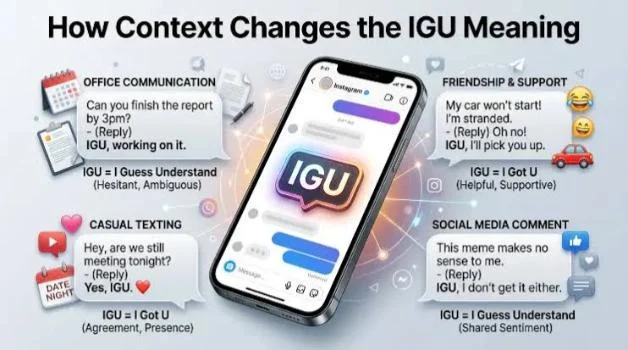
IGU is still seen in online conversations, but it is not as universally recognizable as some older abbreviations such as LOL, BRB, or IDK. Current online references show that people continue to use IGU, but sources disagree about which meaning should be considered the primary one.
This variation is important because internet slang is not controlled by one official dictionary. Different online communities can use the same abbreviation in different ways.
Where you may still see IGU
- WhatsApp chats
- Instagram DMs
- Snapchat
- TikTok comments
- Group chats
- Gaming conversations
- Casual text messages
- Online communities
You may also notice lowercase “igu” instead of uppercase “IGU.” In informal texting, capitalization usually does not change the intended meaning.
Is IGU common with younger users?
It can appear in casual online communication, but usage varies from person to person. Not every teenager or young adult uses IGU, and some people may not recognize it at all.
That is why context remains more useful than assuming a universal slang definition.
If you want your own message to be immediately clear, writing “I got you” or “I give up” is safer than using IGU by itself.
Frequently
What does IGU mean in text?
IGU can mean “I Got You” or “I Give Up” in casual texting. The surrounding conversation determines which meaning makes sense.
Does IGU mean “I Got You”?
Yes. “I Got You” is a common interpretation of IGU in casual online conversations. It can mean “I understand,” “I’ll help,” or “I’ll take care of it.”
Does IGU also mean “I Give Up”?
Yes. Some texting and slang references use IGU for “I Give Up.” This meaning usually expresses frustration, surrender, or playful defeat.
What does IGU mean on Snapchat?
On Snapchat, IGU can have the same meanings as in ordinary texting. It may mean “I Got You” or “I Give Up,” depending on the conversation and tone.
What does IGU mean on Instagram?
In Instagram DMs or comments, IGU is a casual abbreviation. It can mean “I Got You” when someone is offering support or help, or “I Give Up” when someone is expressing defeat.
Is IGU a slang word?
Yes, when used in casual online communication, IGU functions as internet slang or texting shorthand. However, IGU also has technical meanings outside social media.
What does IGU mean in construction?
In construction and window terminology, IGU commonly stands for “Insulated Glass Unit.” It refers to a multi-pane sealed glass assembly and has nothing to do with texting slang.
How do I know which meaning of IGU someone intends?
Check the message before IGU, the topic being discussed, and any emojis. If someone is asking for help, “I Got You” is likely. If they are frustrated with a problem, “I Give Up” may be intended.
Conclusion:
The IGU meaning in text can be confusing because the abbreviation has more than one common interpretation.
In casual online conversations, “I Got You” and “I Give Up” are both used. “I Got You” usually expresses support, understanding, or a willingness to help, while “I Give Up” often shows frustration, surrender, or playful defeat.
The easiest way to understand IGU is to look at the context. Check what the person said before it, notice the tone, and pay attention to emojis. If the meaning still is not clear, asking for clarification is perfectly fine.
Whether you see IGU on WhatsApp, Instagram, TikTok, Snapchat, or in a regular text message, remembering these two main meanings will help you understand the conversation more easily. 😊

Oyner is the creator of DailyWishz, passionate about sharing thoughtful wishes, positive messages, and little moments of joy. He believes the right words can brighten anyone’s day.