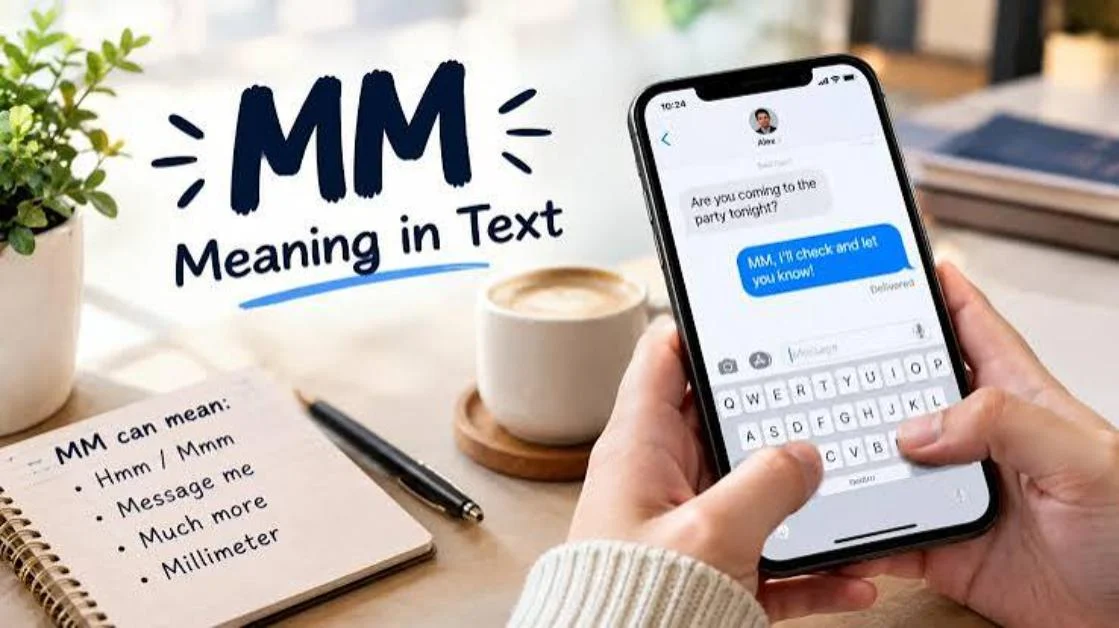
The MM meaning in text can change based on the conversation, the people chatting, and the topic being discussed.
In many messages, MM is used as a short way to express thought, hesitation, or interest. It can also mean “mhm,” which is a casual way to say yes or show that someone is listening.
In other situations, MM may refer to a measurement, a date, or a specific term in business or technology.
People often search for the meaning of MM because they see it in text messages, comments, or social media chats and want to understand what the sender means.
The good news is that this abbreviation is usually easy to understand when you look at the full message.
In this guide, you will learn what MM means in texting, how people use it on popular platforms, and how to reply when someone sends it to you.
What Does MM Mean in Text & Chat?

The meaning of MM in text depends on how it is used. In casual conversations, people may type “mm” to show that they are thinking, agreeing, or reacting to something they have heard. It can also be a way to show interest without writing a full sentence.
For example, if you tell a friend about your weekend plans and they reply with “mm,” they might be listening or thinking about what you said. If they write “mm, sounds good,” the message is more likely to show agreement.
However, MM does not have one fixed meaning in every chat. The tone and surrounding words can help you understand the sender’s intention.
Common meanings of MM in texting include:
- Mhm: A casual way to say yes or show agreement.
- Thinking: A short response that suggests someone is considering something.
- Interest: A reaction that shows curiosity about a topic.
- Enjoyment: Sometimes used to express pleasure, especially when talking about food.
- Measurement: In some contexts, mm stands for millimeters.
Examples of MM in Text Messages
- Friend: “Are you coming over tonight?”
- You: “Mm, I think so.”
Another example:
- Friend: “This cake tastes amazing!”
- You: “Mmm 😋”
In the second example, the extra “m” makes the response sound more like a reaction to something delicious.
The key is to read the entire message instead of assuming that MM always means the same thing.
Full Form, Stands For & Short Meaning of MM
MM does not have one official full form in texting. Its meaning changes with the situation. In casual chats, it may be a shortened form of “mhm” or a simple sound people use to express a reaction.
Unlike abbreviations such as LOL, which commonly means “laughing out loud,” MM can be more flexible. It may show agreement, hesitation, thought, or enjoyment without standing for a specific phrase.
Here are some common interpretations:
- Mhm: Used to agree or confirm something.
- Mm: A sound that may show thinking or interest.
- Mmm: Often used to express enjoyment, especially about food.
- MM: May be an abbreviation for a name, title, or technical term.
- mm: The standard symbol for millimeter, a unit of length.
Is MM Short for Mhm?
Sometimes, yes. People may use “mm” as a quick response when they mean “mhm.” For example, if someone asks, “Did you finish your homework?” and you reply, “Mm,” you might be saying yes.
Still, the meaning is not always clear. A short “mm” can sound uncertain, so the other person may not know whether you agree or are still thinking.
Does MM Have a Romantic Meaning?
MM does not automatically have a romantic meaning. Someone might use it in a friendly, casual, or flirty conversation. The meaning depends on the relationship, the message, and the tone of the discussion.
For example, “Mmm, you look nice 😊” may sound flirty, while “Mm, okay” may simply show acknowledgment.
Always consider the full conversation before deciding what the abbreviation means.
Origin, History & First Known Use of MM
The exact origin of MM as a texting expression is difficult to identify because people have used written sounds and short forms for a long time. Before smartphones and social media, people used informal expressions in letters, notes, and early online chats to show feelings that were hard to express through plain text.
Sounds such as “mm,” “mhm,” and “mmm” are natural parts of everyday speech. People often make these sounds when they are thinking, agreeing, listening, or enjoying something. When digital messaging became common, these spoken reactions moved into text conversations.
As texting developed, users began shortening words and phrases to save time. Instead of writing a complete response, someone could type “mm” to show that they were listening or considering an idea.
How MM Became Common in Digital Chats
Several changes helped short expressions become popular online:
- Text messaging: Short responses made conversations quicker.
- Instant messaging: Users began relying on brief replies during fast chats.
- Social media: Informal language spread across comments, direct messages, and group conversations.
- Mobile keyboards: Quick expressions became easy to type on phones.
- Emojis: Users began combining short sounds with emojis to make their feelings clearer.
For example, “mm 😊” may sound friendly, while “mmm 😋” can express enjoyment.
It is important to understand that there is no widely established single date when MM first appeared in texting. Its use grew naturally from spoken expressions and informal online communication.
Today, MM remains useful because it allows people to react without writing a long message. Its meaning still depends on context, tone, and the relationship between the people chatting.
How People Use MM in Daily Conversations
People use MM in everyday conversations when they want to respond quickly. It can be useful when someone is listening, thinking, agreeing, or reacting to something interesting.
Unlike a complete sentence, MM does not always give a clear answer. That is why the words around it matter. A message such as “Mm, sure” sounds different from “Mm, let me think.”
Common Ways People Use MM
- To agree: “Mm, you’re right.”
- To show they are listening: “Mm, go on.”
- To think about a question: “Mm, I’m not sure.”
- To react to food: “Mmm, this pizza is great! 🍕”
- To show interest: “Mm, tell me more.”
- To respond casually: “Mm, okay.”
MM Between Friends
Friends often use short expressions because they already understand each other’s communication style. If one friend sends a long story, the other may reply with “mm” to show they are following along.
However, a single-letter or short-sound reply may sometimes seem cold. If you want to show stronger interest, you can add a few words.
For example:
- Short reply: “Mm.”
- Clearer reply: “Mm, I get what you mean.”
- Friendly reply: “Mhm, tell me what happened next 😊”
MM at Work or School
In work or school chats, MM may be used informally among people who know each other well. However, it is not always the best choice for professional communication because it can sound unclear.
Instead of replying “mm” to a teacher or manager, you could write:
- “Yes, I understand.”
- “That makes sense.”
- “Let me think about it.”
- “I agree with that idea.”
The best way to use MM is to match the tone of the conversation. It works well in casual chats, but a clearer response is often better when the message is important.
MM Meaning Across WhatsApp, Instagram, TikTok & Snapchat
The MM meaning in text can vary slightly across social media platforms. Although the abbreviation does not have a separate official meaning on every app, the way people use it may depend on the type of conversation.
MM on WhatsApp
On WhatsApp, people often use MM in private chats and group messages. It may show agreement, thought, or a simple reaction.
Examples:
- “Mm, okay. I’ll be there.”
- “Mhm, I understand.”
- “Mmm, that food looks delicious 😋”
The meaning is usually easier to understand when you read the messages before and after it.
MM on Instagram
On Instagram, MM may appear in direct messages, story replies, or comments. People may use it to react to a picture, a personal update, or a conversation.
Examples:
- “Mm, that outfit looks good.”
- “Mhm, I saw your story.”
- “Mmm, this looks amazing 😍”
The expression may sound playful or flirty in some conversations, but it does not automatically indicate romantic interest.
MM on TikTok
TikTok users may type MM in comments or direct messages when reacting to a video. It can express thought, agreement, or enjoyment.
Examples:
- “Mm, that’s actually true.”
- “Mmm, that recipe looks so good.”
- “Mhm, I noticed that too.”
The video itself may help explain the meaning.
MM on Snapchat
On Snapchat, short messages are common, so MM can work as a quick response to a snap or a conversation.
Examples:
- “Mm, nice picture!”
- “Mhm, I remember.”
- “Mmm 😋”
Remember: MM generally has no special platform-specific definition. The context of the message matters more than the app where you see it.
Different Meanings of MM in Other Fields
Outside texting and social media, MM can have several meanings. This is important because not every use of MM is slang. In technical writing, business, education, and everyday measurements, it may refer to something completely different.
Here are some common examples.
1. MM as Millimeter
In measurements, mm is the standard symbol for a millimeter. One millimeter equals one-thousandth of a meter.
For example:
- “The screen is 5 mm thick.”
- “Cut the board to 20 mm.”
- “The gap measures 2 mm.”
In these examples, mm refers to length, not a chat expression.
2. MM in Roman Numerals
In Roman numerals, M represents 1,000. Therefore, MM represents 2,000.
For example, MMXXVI represents 2026. Roman numerals often appear on monuments, clocks, book titles, and special dates.
3. MM in Business and Finance
Some companies use MM to represent one million in financial documents. This convention is common in certain accounting and financial settings, but it is not universal.
For example, a report might use “$5MM” to mean five million dollars. Always check the document’s notation rules before interpreting it.
4. MM in Education and Professional Titles
MM may be used as an abbreviation for different degree names, qualifications, or job-related terms. Its meaning depends on the institution and field.
5. MM in Names and Entertainment
MM can also appear as initials, a brand abbreviation, or a short label for a product or project.
The best way to understand MM is to look at the surrounding information. A number followed by mm usually indicates a measurement, while MM in a casual message may express a reaction or acknowledgment.
Common Confusions, Mistakes & Wrong Interpretations
Because MM is short, it is easy to misunderstand. The same letters can express different feelings depending on how they are written and where they appear.
One common mistake is assuming that MM always means “yes.” Sometimes it signals agreement, but it can also show that someone is thinking or is unsure.
Common Mistakes to Avoid
- Assuming MM always means yes: The sender may be thinking rather than agreeing.
- Confusing MM with MHM: These expressions can have similar uses, but they are not always interchangeable.
- Treating MM as automatically romantic: A message containing MM is not proof of flirting.
- Ignoring the conversation: The previous message often explains the intended meaning.
- Confusing MM with mm in measurements: Lowercase mm usually represents millimeters in technical writing.
- Reading too much into punctuation: “Mm,” “mm.” and “mmm!” may suggest different tones, but punctuation alone cannot prove someone’s feelings.
Why Does MM Sometimes Sound Rude?
A short reply can feel unfriendly when you expect a detailed answer. For example, if you tell someone important news and they respond only with “mm,” you may wonder whether they care.
However, they might be busy, distracted, or unsure what to say. The message alone does not reveal their full intention.
How Can You Avoid Misunderstanding MM?
Look at the full conversation and consider your relationship with the sender. If you need a clear answer, ask a simple follow-up question.
For example:
- “Do you mean yes?”
- “Are you thinking about it?”
- “I’m not sure I understand. What do you mean?”
These questions help you avoid guessing. It is usually better to ask politely than to assume that a short message has a negative meaning.
Similar Terms, Alternatives & Related Slang
Several texting expressions are similar to MM. Learning the differences can help you understand short replies and use them naturally.
Common Alternatives to MM
- MHM: Often means yes or indicates that someone is listening.
- Hmm: Usually suggests thought, doubt, or uncertainty.
- Mmm: Often expresses enjoyment, pleasure, or interest.
- Yup: A casual way to say yes.
- Yep: Another informal way to agree.
- Yeah: A common word for agreement.
- IKR: Stands for “I know, right?” and shows agreement or shared feelings.
- IDK: Means “I don’t know.”
- LOL: Means “laughing out loud,” often used to show amusement.
- Ooh: Expresses surprise, interest, or excitement.
MM vs. MHM
MHM often sounds like a direct acknowledgment. For example, “Did you call her?” followed by “Mhm” usually suggests yes.
MM may be more open to interpretation. It could mean yes, but it could also indicate thought or interest.
MM vs. Hmm
Hmm often suggests that someone is considering an idea or questioning something.
Example:
- “Hmm, that sounds unusual.”
- “Mm, I understand.”
The first sounds more thoughtful or uncertain, while the second may show acknowledgment.
MM vs. Mmm
Mmm often expresses enjoyment, especially when discussing food, music, or something appealing. Adding another “m” can make the reaction feel stronger.
Example:
- “Mm, okay.” — Acknowledgment.
- “Mmm, chocolate cake! 🍰” — Enjoyment.
These differences are not strict rules. People use texting expressions in personal ways, so the surrounding words and tone remain important.
Examples of MM in Real Chat Situations
The easiest way to understand MM is to see how it works in real conversations. These examples show how the same expression can communicate different ideas.
1. MM as Agreement
- Alex: “We should meet at 6.”
- Sam: “Mm, sounds good.”
Here, MM suggests agreement because the sender adds a positive phrase.
2. MM as a Thinking Sound
- Alex: “What should we eat tonight?”
- Sam: “Mm, maybe pizza?”
In this conversation, MM shows that Sam is thinking about the options.
3. MM as a Sign of Listening
- Alex: “Then I went to the store and saw my old friend.”
- Sam: “Mhm, what happened next?”
Here, MHM shows that Sam is following the story.
4. MM in a Flirty Conversation
- Alex: “I tried a new outfit today.”
- Sam: “Mmm, I bet you looked great 😊”
This response may sound flirty because of the compliment, but the meaning comes from the whole message, not just MM.
5. MM as a Food Reaction
- Alex: “Look at this chocolate cake!”
- Sam: “Mmmm 😋 I need a slice.”
The longer expression suggests enjoyment and excitement about the food.
6. MM as an Uncertain Reply
- Alex: “Do you think we should cancel?”
- Sam: “Mm, I’m not sure.”
Here, MM introduces hesitation.
7. MM in a Short Reply
- Alex: “I’ll message you later.”
- Sam: “Mm, okay.”
This may simply acknowledge the message. If the sender wants to be clearer, they could say, “Okay, talk later!”
These examples show why it is important to read the full message before deciding what MM means.
How to Reply When Someone Says MM
Your reply should depend on what the other person seems to mean. Since MM can express agreement, thought, enjoyment, or uncertainty, there is no single response that works in every situation.
If MM Means Agreement
If the person seems to agree with you, keep the conversation moving.
Examples:
- “Great! 😊”
- “Perfect, see you then.”
- “Glad we’re on the same page.”
If MM Means They Are Thinking
Give them time to decide. You do not need to push for an immediate answer.
Examples:
- “Take your time.”
- “Let me know what you think.”
- “No rush!”
If MM Shows Interest
If the person seems curious, share more information.
Examples:
- “Want to hear the full story?”
- “There’s more to it!”
- “I’ll explain everything.”
If MM Seems Flirty
You can respond in a friendly way if you are comfortable with the conversation.
Examples:
- “Haha, what does that mean? 😄”
- “You’re being mysterious.”
- “Is that a good thing? 😉”
You do not have to flirt back if you do not want to.
If You Cannot Understand the Message
The simplest option is to ask what the person means.
Examples:
- “Do you mean yes?”
- “What are you thinking?”
- “I’m not sure I follow.”
Tip: Avoid assuming that a short reply means the person is angry or uninterested. If the conversation matters, ask a clear question instead of guessing.
Is MM Still Popular? Trends & Online Usage

MM remains useful in informal messaging because short expressions are easy to type and can make conversations feel natural. People continue to use sounds such as “mm,” “mhm,” and “mmm” in everyday chats, comments, and direct messages.
However, MM is not always used as a formal abbreviation with one agreed meaning. Its use depends on personal habits, age groups, language, and the type of conversation. Some people prefer “mhm” when they mean yes, while others type “mm” or “yeah.”
Why Do People Still Use MM?
- It is quick: A short response saves time.
- It feels natural: It resembles sounds people make during spoken conversations.
- It can express emotion: A longer “mmm” may show enjoyment.
- It fits casual chats: Friends often use short replies instead of complete sentences.
- It is flexible: The same expression can communicate different reactions.
Is MM Popular on Social Media?
MM can appear on platforms such as WhatsApp, Instagram, TikTok, and Snapchat, but there is no single meaning shared by every user. It is better understood as a casual expression than as a clearly defined, trend-specific acronym.
It is also important not to confuse continued everyday use with proof that MM is currently trending. Without reliable platform data, it would be inaccurate to claim that its popularity is rising or falling.
If you want to use MM, consider your audience. It works well when chatting with friends, but a complete sentence is often better for important conversations, schoolwork, or professional messages.
Overall, MM remains a simple way to react in text. Understanding its context is more useful than memorizing only one definition.
Frequently Asked Questions
1. What does MM mean in text messages?
MM may mean “mhm,” express thought, or show interest or enjoyment. The exact meaning depends on the conversation.
2. Does MM mean yes in texting?
Sometimes. People may use MM as a casual acknowledgment or a form of agreement. However, it can also express uncertainty, so check the surrounding words.
3. What does MM mean from a girl?
A girl may use MM to agree, think about something, or react to a message. It does not automatically mean she is flirting or has romantic feelings.
4. What does MM mean from a guy?
A guy may use MM as a short acknowledgment, a thinking sound, or a reaction. His intended meaning depends on the context and his usual texting style.
5. What does MHM mean in chat?
MHM is commonly used to mean yes or to show that someone is listening. It is similar to saying “uh-huh” in spoken conversation.
6. What is the difference between MM and MHM?
MM can show thought, interest, or acknowledgment, while MHM more often signals agreement or that someone is listening. Their meanings can overlap.
7. Does MM mean something romantic?
Not by itself. MM may appear in a flirty conversation, but the rest of the message is more important when deciding whether someone is flirting.
8. What does MM mean on WhatsApp?
On WhatsApp, MM usually has the same informal meanings it has in other chats. It may show agreement, thought, or a reaction to something.
9. What does mm mean in measurements?
In measurements, mm stands for millimeter. One millimeter equals one-thousandth of a meter.
10. How should I reply when someone texts MM?
You can reply with “Okay,” “What do you think?” or “Do you mean yes?” Choose a response that fits the conversation and ask for clarification if needed.
Conclusion:
The MM meaning in text depends on the situation, but it often expresses thought, agreement, interest, or a simple reaction.
In casual conversations, it may be used like “mhm” to show that someone is listening or saying yes. A longer version, such as “mmm,” can also express enjoyment, especially when talking about food or something appealing.
On WhatsApp, Instagram, TikTok, and Snapchat, MM generally follows the same informal patterns rather than having a special meaning on each platform.
It is also important to remember that MM does not automatically indicate flirting, anger, or a lack of interest.
When you receive this expression, look at the full message and the conversation around it. If you are unsure, ask a friendly follow-up question.
Understanding the context will help you interpret MM correctly and respond naturally in your everyday chats.

Oyner is the creator of DailyWishz, passionate about sharing thoughtful wishes, positive messages, and little moments of joy. He believes the right words can brighten anyone’s day.